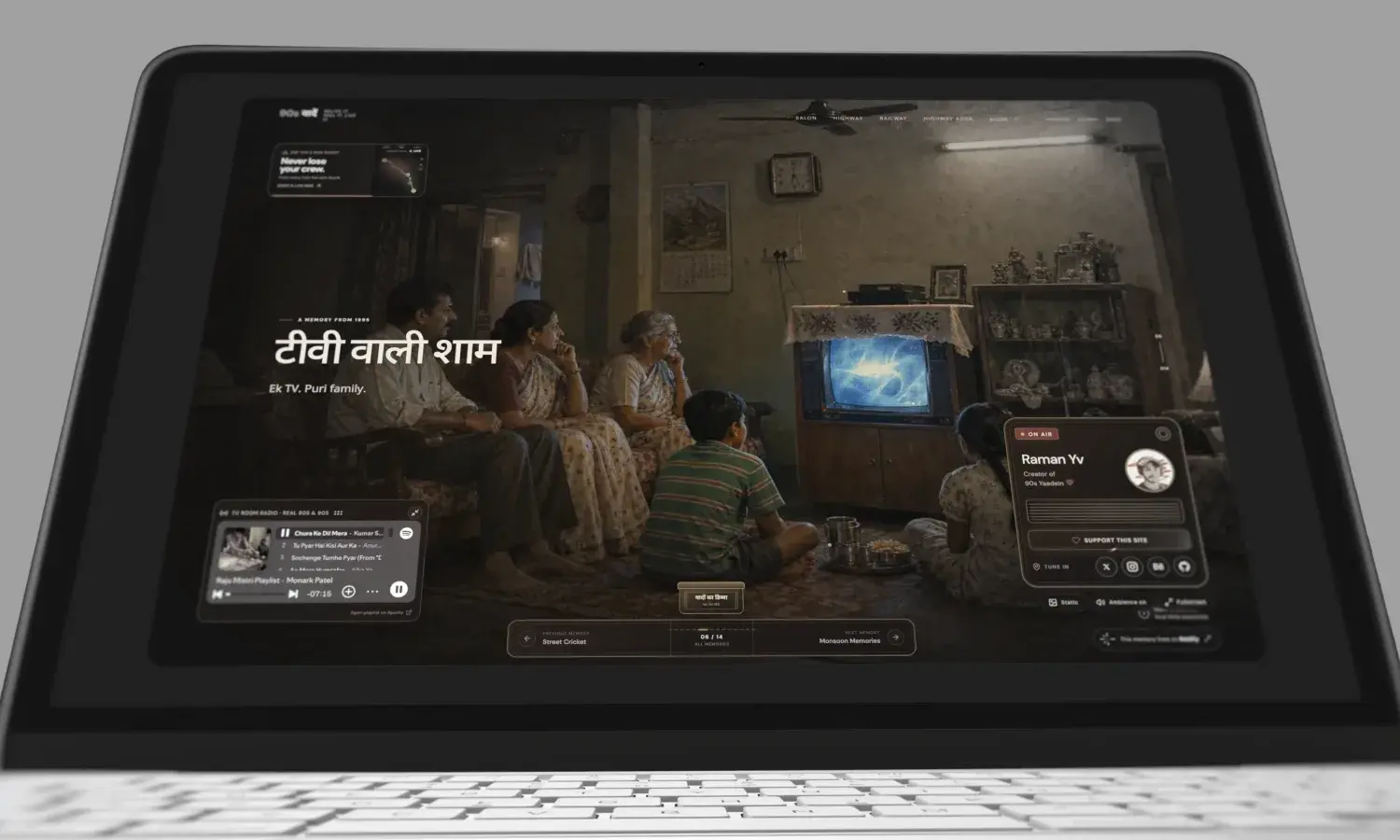
I built a small website around a feeling I could not stop thinking about: what if the internet could feel like childhood again?
Not a polished archive of the 1990s. Not a list of old television shows. Not another page covered with retro fonts and cassette-tape illustrations.
I wanted to recreate the emotional texture of growing up in India during the 90s—the sound of a television in the next room, cricket played with bricks as wickets, summer afternoons that seemed endless, neighbourhood friendships and ordinary things that became precious only after they disappeared.
The experiment became my 90s nostalgia website.
Then something happened that I genuinely did not expect.
Within days, the website reached approximately 16,000 active users and recorded around 149,000 events in Google Analytics. Netlify noticed the project and awarded me 20,000 platform credits. Even more surreal for me as an independent designer, Netlify’s CEO liked my tweet about it.
This is not a story about discovering a secret growth hack. It is a story about emotional design, cultural specificity and what can happen when you make something people do not merely use—they recognise themselves inside it.
The idea began with a feeling, not a feature list
Most digital products begin with a familiar question:
What problem does this solve?
This one began with a different question:
Can a website make someone feel the exact moment their childhood returns to them?
I kept thinking about the Indian internet of the 90s and early 2000s, but not only as a visual style. Nostalgia is often reduced to a collection of props: VHS noise, pixel type, old computers, film grain and faded photographs.
Those things can establish a period. They cannot create a memory by themselves.
The emotional core lives somewhere else:
- The television programme everyone watched at the same time
- A cricket bat left beside two bricks after sunset
- A landline ringing across the house
- A cassette recorded from the radio
- A bicycle waiting outside a friend’s home
- A roadside dhaba stop with your riding group
- The strange silence of a playground after everyone has gone home
None of these memories is spectacular. That is exactly why they matter. They belong to everyday life, and everyday life is where nostalgia becomes personal.
Why 90s nostalgia still connects so deeply in India
Indian 90s nostalgia is not just affection for old objects. It represents a particular rhythm of life.
Entertainment felt shared. Television had fewer channels, which meant millions of people often carried the same references. Friendship was more physical and local. Waiting was normal. Photographs were limited. Music had to be found, recorded, borrowed or protected. The internet was rare enough to feel like an event.
People do not necessarily want all of that inconvenience back. They miss the emotions built around it: anticipation, community, discovery and attention.
That became the design opportunity.
Instead of making a website that tells visitors, “Here are things from the 90s,” I wanted it to say, without explaining itself:
You were there too.
That difference changed the project.
Designing memory instead of decorating with retro objects
The most important design decision was to treat every screen as a scene rather than a content section.
A typical nostalgia website might show a grid of old products, posters and photographs. That can be informative, but it places the visitor outside the memory, looking in.
I wanted visitors to feel present.
So the experience leaned into atmosphere:
- Full-screen environments instead of ordinary content cards
- Familiar Indian settings rather than generic Western retro imagery
- Sound and motion used as emotional cues
- Small interactive discoveries instead of long explanations
- Cinematic lighting that makes the scenes feel remembered, not documented
- Details that reward people who slow down and explore
The goal was never visual accuracy alone. Memory itself is selective. It sharpens one object, softens another and fills the distance with feeling. The design needed to work the same way.
Cultural specificity made the experience more universal
There is a common fear in design that being too culturally specific will make a product less accessible.
My experience was the opposite.
The more honestly the website reflected Indian childhood—the architecture, household objects, television culture, neighbourhood lanes and social rituals—the more strongly people connected with it.
Specific details create trust. They tell visitors that the person who made the experience understands the memory from the inside.
And even when someone did not share the exact reference, they could recognise the larger feeling: growing up, losing time and remembering a world that no longer exists in quite the same way.
Good emotional design does not need everyone to share the same memory. It needs the emotion beneath that memory to be true.
The traffic spike I did not expect
When I released the project, I hoped a few people would explore it and understand what I was trying to make.
Instead, traffic rose sharply.
My Google Analytics snapshot showed:
- 16,000 active users
- 16,000 new users
- 149,000 recorded events
- A dramatic peak around 11 August 2026
These numbers are especially meaningful to me because the project did not begin as a growth campaign. It was a personal design experiment built around an emotional idea.
The ratio between users and events also suggested that people were not merely landing on the page and leaving immediately. On average, the recorded totals equal more than nine events per active user. That is not a complete engagement analysis—analytics events depend on how tracking is configured—but it is a useful signal that visitors were interacting with the experience.
The project gave people something worth opening, exploring and sharing.
Why people shared the website
Virality is often discussed as if it comes from algorithms alone. Distribution matters, of course, but people still need a reason to pass something to another person.
Nostalgia has a natural sharing loop:
- A person recognises a memory.
- The memory creates an emotion.
- The emotion brings a specific person to mind.
- They share the experience with that person.
- The recipient discovers their own memory and continues the loop.
The website was not only content to consume. It became a prompt for conversation:
- “Do you remember this?”
- “This was exactly our childhood.”
- “We used to do this too.”
- “Send this to the 90s kid in your group.”
The best share button is sometimes the feeling that another person needs to see what you just saw.
The unexpected Netlify reward
The traffic created a less romantic problem: infrastructure usage.
The project was hosted on Netlify, and the sudden attention rapidly consumed resources. For an independent creator, a viral spike can be both exciting and stressful. You want people to experience the work, but you also start wondering whether the site will remain online and what the unexpected usage will cost.
I shared the situation publicly.
Netlify responded by awarding the project 20,000 credits. Their CEO also liked my tweet.
To be precise, this was a platform-credit reward—not a cash prize—and a social like is not the same thing as a formal company endorsement. But personally, both moments meant a lot.
A website that began as my attempt to preserve a feeling had travelled far enough to be noticed by the platform helping me keep it online.
For a solo multidisciplinary designer, that kind of recognition feels enormous.
What the project taught me about emotional web design
The numbers were exciting, but the lessons are more useful than the spike.
1. Begin with an emotional sentence
Before deciding the sections, framework or visual system, define what the visitor should feel.
For this project, the sentence was simple:
Childhood ended quietly, and we noticed only years later.
That idea could guide imagery, pacing, sound, interaction and writing. A feature list could not.
2. Familiar details outperform generic polish
A technically beautiful scene can still feel empty. One culturally accurate detail can carry more emotional weight than twenty decorative effects.
The right brick wicket, wall texture, television glow or street corner does more than establish a setting. It activates memory.
3. Sound is part of interface design
In a nostalgic experience, audio is not background decoration. It can become navigation through emotion.
The hum of an old room, distant children playing, a television theme or a cassette click can make a static visual feel inhabited. Sound should remain optional and respectful, but when used carefully it adds a dimension that visual design cannot reproduce alone.
4. Interaction should deepen the story
Not every object needs to move. Not every scroll needs an animation.
The most useful interactions are the ones that reveal something: turning on a television, entering a scene, hearing a familiar sound or discovering a detail that feels privately remembered.
Motion without meaning creates spectacle. Motion with emotional purpose creates presence.
5. Make sharing feel like remembering together
People rarely share a website because its grid is well aligned. They share it because it expresses something they want another person to feel.
The project worked best when it felt less like my portfolio piece and more like a shared room people could invite their friends into.
The role of AI in building the experience
AI helped me explore ideas that would once have been difficult for an independent designer to execute alone.
It supported visual experimentation, scene development, prototyping and the movement from an imagined atmosphere to something interactive. But AI did not decide which memories mattered, what felt authentically Indian or when a visual was technically impressive but emotionally wrong.
Those decisions came from lived experience and design judgment.
This project strengthened something I already believed: AI is most valuable when it increases the number of directions we can explore, while the human remains responsible for taste, context and meaning.
The tool can generate an old television. It cannot know why the television mattered in your home.
What I would do differently next time
A sudden traffic spike reveals weaknesses very quickly.
If I were preparing another experimental website for the same response, I would think about these areas earlier:
- Establish analytics events intentionally before launch
- Optimise large images, sound and video for unpredictable traffic
- Use lazy loading without damaging the cinematic experience
- Test the most important scenes on low-powered mobile devices
- Set hosting-usage alerts before sharing publicly
- Build graceful fallbacks when heavy media cannot load
- Make social previews as carefully as the website itself
- Capture qualitative feedback alongside traffic numbers
Creative projects still need operational design. The more emotionally successful an experience becomes, the more important its invisible technical foundation becomes.
Is nostalgia enough to make a website viral?
No.
Nostalgia can attract attention, but recognition without craft becomes a gimmick. A collection of old references may earn a quick smile and then disappear.
For nostalgia to become a meaningful digital experience, it needs:
- A clear point of view
- Specific cultural observation
- Thoughtful art direction
- Restraint
- A reason to interact
- A reason to share
- Enough performance and reliability to survive attention
The past is not automatically interesting. The designer’s job is to reveal why it still matters now.
The real success was not the number
Sixteen thousand users is a milestone I am proud of. So are 149,000 events, 20,000 Netlify credits and an unexpected like from the company’s CEO.
But the most meaningful part was seeing people recognise their own lives in something I made.
For a brief moment, the website stopped belonging only to me. It became a place where strangers arrived carrying different versions of the same childhood.
That is what I want to remember from this project.
Design can make a product easier to use. It can make a brand easier to recognise. And sometimes, if the idea is honest enough, it can make thousands of people feel that they have returned somewhere they thought was gone.
Frequently asked questions
What is the 90s nostalgia website?
It is an interactive web experience inspired by growing up in India during the 1990s. Instead of functioning only as an archive, it uses cinematic scenes, familiar details and interaction to recreate the emotional atmosphere of childhood memories.
How did the nostalgia website go viral?
There was no single trick. The strongest growth loop came from emotional recognition: visitors saw memories they associated with their own childhood and shared the website with friends and family who had lived through the same era.
How much traffic did the website receive?
A Google Analytics snapshot from August 2026 showed approximately 16,000 active users, 16,000 new users and 149,000 recorded events, with the largest spike occurring around 11 August.
What did Netlify award the project?
Netlify awarded 20,000 platform credits after the traffic spike and hosting-usage situation was shared publicly. The credits were a hosting-platform reward, not a cash prize.
Did Netlify endorse the website?
Netlify supported the project with platform credits, and the company’s CEO liked my tweet. I see this as a meaningful moment of recognition, but I do not describe a social-media like as a formal commercial endorsement.
Can AI help create an interactive nostalgia website?
Yes. AI can accelerate visual exploration, prototyping and implementation. However, cultural authenticity, emotional direction, editing and design judgment still need a human author—especially when the experience depends on personal or collective memory.
What makes emotional web design effective?
Effective emotional design connects visual choices, sound, interaction, copy and pacing to one clear feeling. It uses specific details and purposeful interaction rather than relying on decorative effects alone.
Have an idea people should feel—not merely use?
I help founders and teams shape thoughtful digital products, brands and interactive experiences through design, storytelling and technology.