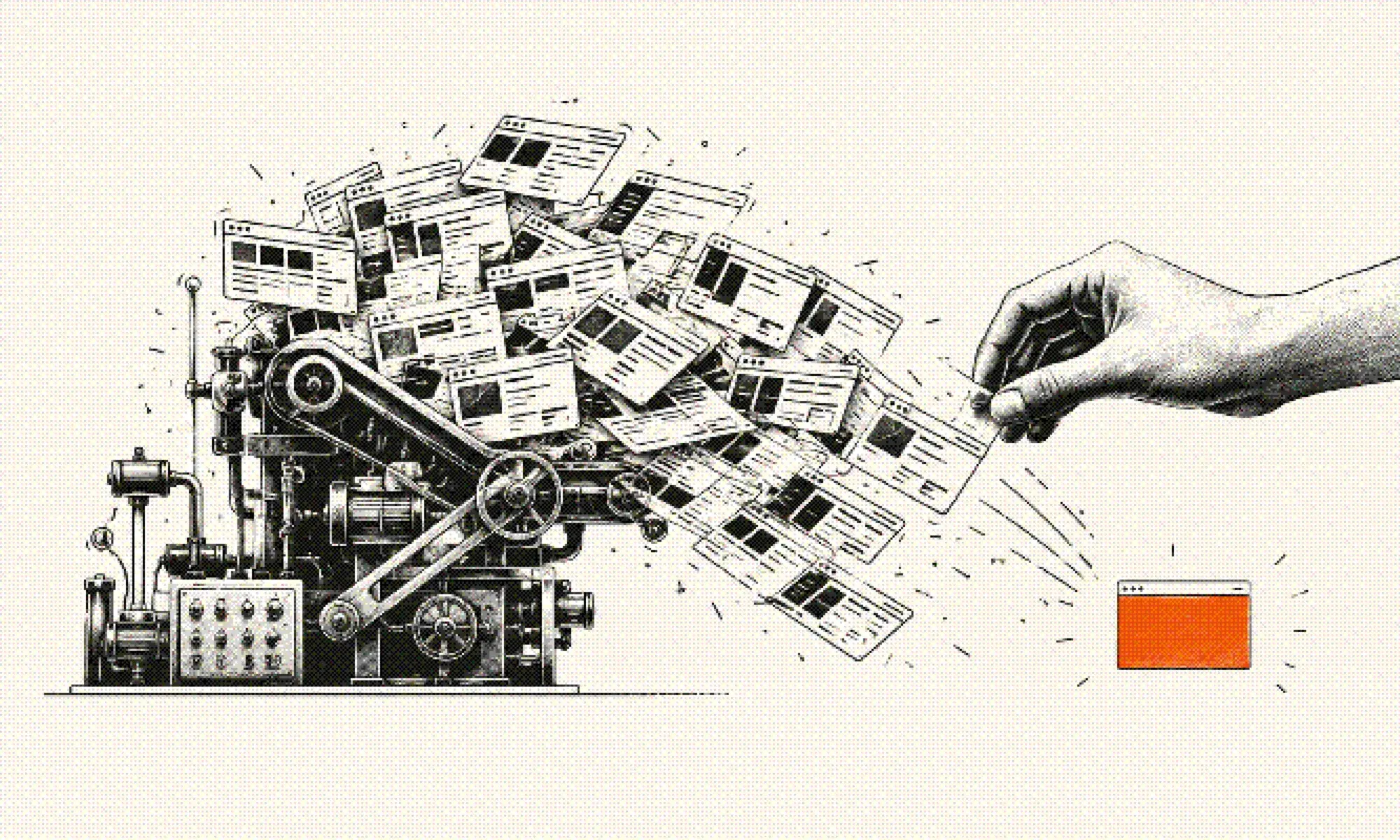
AI Can Design Screens Now. So What Is a Designer Actually For?
For most of my career, turning an idea into a digital product took time.
You had to understand the problem, explore ideas, design interfaces, prototype interactions, and work with developers to make it real.
Today, you can describe an idea in a few sentences and watch AI generate an interface—or even a working prototype—in minutes.
That raises an uncomfortable question:
If anyone can generate a beautiful interface, what exactly is a designer for?
I don’t think the answer is making better screens.
I think the role of the designer is becoming much more important.
The cost of making interfaces is approaching zero
AI is rapidly removing the barriers between an idea and execution.
A prompt can generate a landing page.
A sketch can become an interface.
A screenshot can become code.
A conversation can become a prototype.
That is incredibly powerful.
But there is an important distinction:
AI makes it easier to create something. It does not automatically make that thing worth creating.
We are entering an era where producing interfaces will become incredibly cheap.
The internet will not suffer from a shortage of screens.
It will suffer from a shortage of good decisions.
AI can generate a beautiful dashboard with navigation, cards, charts and polished typography.
But it cannot automatically answer:
Why should this product exist?
What does the user actually need?
What information matters most?
What should we remove?
What happens when something goes wrong?
These are not simply interface questions.
They are design questions.
Good design was never about drawing rectangles
Designers often describe themselves through tools: Figma, Photoshop, Illustrator, Framer.
But tools have never been the real skill.
A designer’s real job is understanding a messy problem and finding clarity inside it.
I think of design roughly like this:
Complexity → Understanding → Decisions → Simplicity
The interface is simply the visible result.
AI can dramatically accelerate execution.
But deciding what should be created in the first place remains much harder.
Designers are becoming editors
AI introduces something designers have never had at this scale:
Infinite possibilities.
Previously, exploring ten directions might take days.
Now we can generate dozens in minutes.
So the valuable question changes from:
Can you create an option?
to:
Can you recognize the right option?
That requires judgment, taste, context and restraint.
AI can generate fifty possibilities.
A good designer knows which forty-nine to delete.
As creation becomes easier, curation becomes more valuable.
Taste will matter more, not less
If everyone has access to similar AI models, components and generation tools, products can quickly begin to feel the same.
Technically polished.
Visually competent.
Completely forgettable.
The differentiator becomes taste.
Taste comes from years of observing, making, failing, comparing and questioning.
It is knowing when something is visually impressive but strategically wrong.
Knowing when to add.
And more importantly, knowing when to remove.
When AI can generate almost anything, knowing what not to create becomes a superpower.
The most important skill may be asking better questions
AI will enthusiastically solve the problem you give it.
Even when you give it the wrong problem.
Imagine someone says:
“We need an AI chatbot on our homepage.”
AI can design one immediately.
A designer should first ask:
Why?
Do customers actually need conversation?
Would better navigation solve the problem?
Could search be faster?
Should AI even be visible?
The quality of what we create increasingly depends on the quality of the question that comes before it.
That makes problem framing one of the most valuable skills designers can develop.
Designers who only produce screens are vulnerable
Some design work will absolutely become automated.
Basic wireframes.
UI variations.
Landing pages.
Component assembly.
Production resizing.
Simple prototypes.
Trying to compete with AI purely on execution speed is probably a losing strategy.
The opportunity is to move upward:
Screen maker → Problem solver
Executor → Decision maker
Pixel producer → Product thinker
Tool operator → Creative director
The closer your value is to judgment, strategy, systems thinking and understanding people, the harder that value becomes to replace.
AI should increase ambition, not just speed
The least interesting use of AI is:
“I used to design five screens. Now I can design twenty.”
That is productivity.
But the more exciting question is:
What can I create now that I couldn’t create before?
A designer can increasingly take an idea, research it, design it, prototype it, use AI-assisted coding to make it functional, test it and potentially ship it.
The distance between designer and builder is shrinking.
That may be one of the biggest opportunities AI creates.
Designers do not need to become experts at everything.
But understanding product, UX, visual design, brand, writing, technology and business makes it easier to connect disciplines and make better decisions.
The screen was never the product
The Figma file is not the product.
The design system is not the product.
The prototype is not the product.
The product is the experience someone has while trying to accomplish something.
Did we make it clearer?
More useful?
More intuitive?
Did we remove unnecessary complexity?
Did we solve something that actually mattered?
Those questions existed before AI.
And they will remain important long after today’s AI tools have changed.
So, what is a designer actually for?
To make sense of complexity.
To ask questions others overlooked.
To understand people.
To connect business, technology and human needs.
To recognize what matters.
To remove what doesn’t.
To turn ideas into something useful.
AI can help us do all of this faster.
But speed was never the point.
The point is making something worth making.
Perhaps the future of design belongs not to the people who can generate the most—
but to the people who know what deserves to exist.